Exploring how cloud formations influence prop selections across racetracks, tennis courts, and baseball diamonds in integrated digital environments
Written by Wendy Keller · Jul 16, 2026

Exploring how cloud formations influence prop selections across racetracks, tennis courts, and baseball diamonds in integrated digital environments
Cloud formations provide measurable indicators of atmospheric conditions that shape outdoor athletic events, and integrated digital platforms now incorporate satellite imagery along with ground sensors to refine prop selections for horse racing, tennis, and baseball. Observers note that cirrus clouds often precede shifts in wind speed and humidity, while cumulonimbus structures signal potential precipitation that alters track surfaces or court traction within minutes. Data streams from these sources feed directly into wagering applications, allowing real-time adjustments to over-under totals and player-specific metrics during live sessions.
Atmospheric patterns and their measurable effects on performance metrics
Researchers at institutions such as the National Oceanic and Atmospheric Administration have documented how high-altitude cloud layers correlate with temperature drops that affect equine stamina on racetracks, where a two-degree Celsius decline can extend average finish times by fractions of a second. Similar patterns appear in tennis, where increased cloud cover reduces solar radiation and slows ball velocity, prompting platforms to recalibrate serve percentage props accordingly. In baseball, scattered altocumulus formations frequently coincide with gustier conditions that elevate strikeout rates for certain pitchers, a relationship quantified through historical play-by-play archives linked to concurrent weather logs.
Integration of satellite data into unified wagering systems
Digital environments synchronize cloud analysis with event timelines through application programming interfaces that pull from multiple meteorological feeds, creating layered dashboards for users tracking props across venues. One platform development documented in July 2026 demonstrated how automated alerts triggered by incoming frontal systems adjusted baseball diamond props within 90 seconds of cloud detection updates, while parallel modules handled racetrack moisture projections and tennis court dew point calculations. These systems rely on convolutional neural networks trained on archived imagery paired with performance outcomes, yielding probability shifts that operators publish alongside traditional statistical models.
Venue-specific responses across racetracks, courts, and diamonds
Racetrack operators have observed that stratus decks extending over oval circuits increase the likelihood of softer turf, which in turn elevates place and show prop volumes for closers rather than front-runners. Tennis facilities report analogous adjustments when convective cloud buildups raise humidity levels, lengthening rally durations and influencing game-total selections in live interfaces. Baseball stadiums experience parallel dynamics, as broken cloud cover reduces glare and changes outfield tracking angles, data points that feed into at-bat outcome models displayed within the same mobile ecosystems.
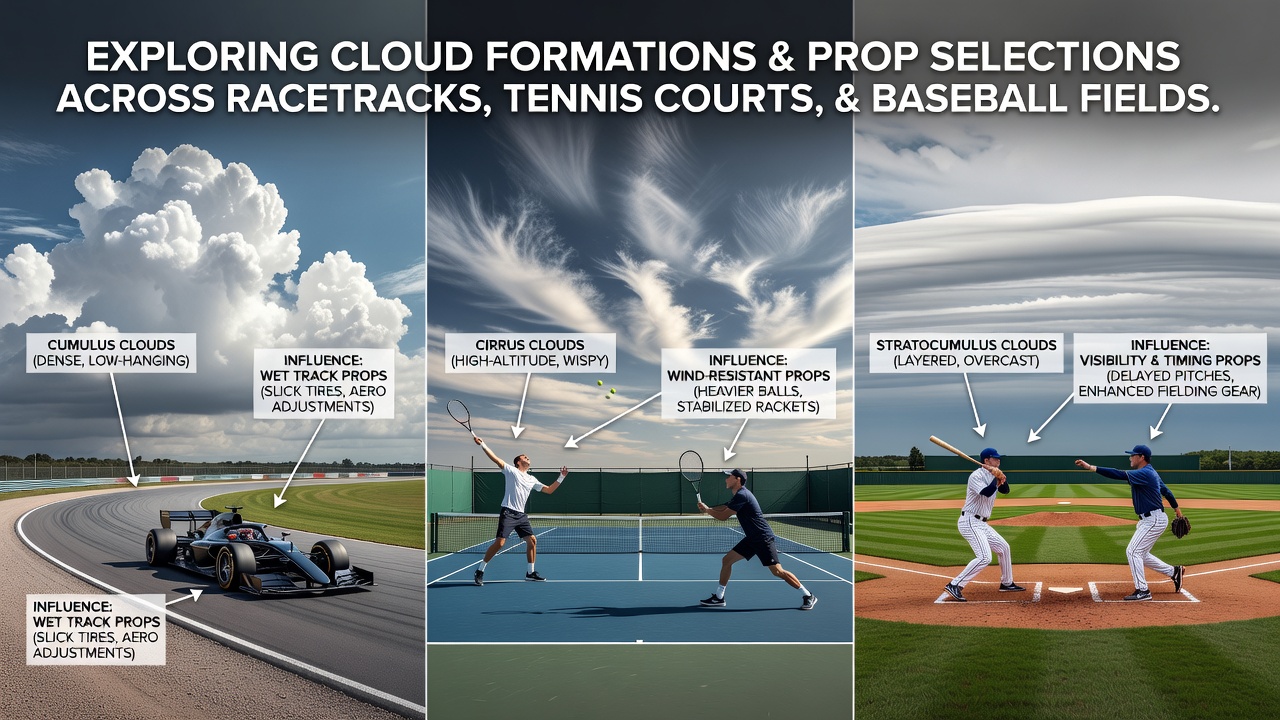
Cross-venue synchronization occurs when platforms aggregate these inputs into single-session interfaces, letting participants monitor multiple props without switching applications. A 2025 industry report from the Canadian Gaming Association highlighted that operators incorporating cloud-derived variables recorded higher session retention during variable weather periods, particularly when alerts aligned with in-play windows at simultaneous events.
July 2026 developments in real-time modeling
During July 2026, several platforms expanded their use of geostationary satellite loops to generate minute-by-minute cloud movement forecasts, integrating these with venue-specific wind sensors at major racetracks, tennis complexes, and baseball parks. The resulting models produced updated prop lines for wind-assisted home run totals and serve hold percentages that reflected incoming cloud shadows, while racetrack modules projected changes in rail bias due to shifting humidity. These enhancements occurred alongside regulatory updates in multiple jurisdictions that required disclosure of algorithmic weather components in prop offerings.
Cross-sport data alignment in digital ecosystems
Integrated environments allow parallel tracking of cloud effects across disciplines because standardized meteorological parameters translate into comparable performance variables. A study released by the Australian Bureau of Meteorology in partnership with sports analytics groups identified consistent correlations between cloud optical depth readings and reduced sprint speeds on turf surfaces, findings that mirrored observations from tennis court friction tests and baseball outfield carry distances. Platforms apply these alignments to create unified risk profiles, enabling simultaneous management of props drawn from all three venue types within single user accounts.
Conclusion
Cloud formation data continues to expand its role within digital wagering frameworks by supplying verifiable atmospheric inputs that refine prop selections for racetracks, tennis courts, and baseball diamonds. As modeling techniques advance, the linkage between satellite observations and live event metrics strengthens, producing more granular adjustments that reflect real environmental conditions across integrated platforms.